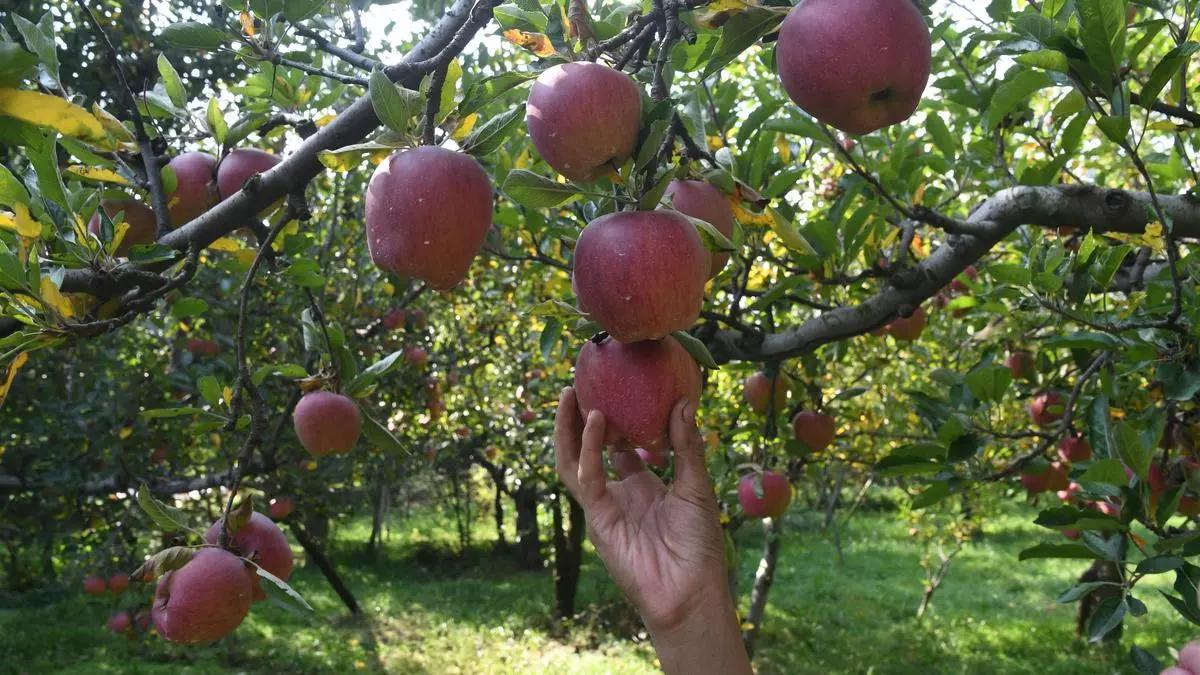
Boost for Kashmir apples
Jammu and Kashmir’s (J&K’s) apple industry, the backbone of its agrarian economy, has shaped the region’s social and economic fabric for centuries.
As the largest producer of apples in India, the valley’s orchards not only support thousands of livelihoods but also position the region on the global fruit market map.
Apple farming is the largest employment generator in J&K, with nearly 3.
5 million farmers — 27 per cent of the region’s population — involved in growing the fruit, whose export contributes more than 8 per cent to the region’s GDP.
However, behind this thriving industry lies a crisis of fluctuating market forces, geopolitical tensions, and environmental challenges.
Threats and challenges
Kashmir’s apple growers are increasingly relying on cold storage units to navigate fluctuating demand.
With over 40 cold storage facilities, mostly in SIDCO Lassipora, capable of holding more than 2.
5 lakh tonnes, these controlled-atmospheric units provide a crucial buffer.
However, with limited cold storage in Kashmir, many apple growers are left with no choice but to sell early at low prices, or risk watching their produce go to waste.
The influx of foreign apples has driven down prices for Kashmiri apples, leaving local growers struggling against a tide of cheaper imports.
The flood of Iranian, Washington, and South African apples has sharply eroded the dominance of Kashmiri apples.
J&K’s apple industry is hindered by the region’s rugged terrain and insufficient infrastructure.
The fragile transportation network, often blocked by political instability or harsh weather, further impedes the timely distribution of produce.
Erratic weather patterns, particularly frequent hailstorms, devastate orchards.
Reviving the orchard
A growing demand for organic and premium apple varieties is reshaping the market, driven by health-conscious consumers.
The apple growers in Kashmir are unable to produce organically grown apples.
Promoting traditional apples grown organically in Kashmir is essential to safeguard health and preserve the region’s agricultural heritage and enhance sustainability.
Hanabi — an innovative solution (advanced pesticide) to boost apple farming in Kashmir — must be used in the early stage of rat infestation.
The National Conference, now at the helm in J&K, must turn their promises into action, especially when it comes to the apple industry.
The new government must craft a robust natural farming policy, and must enhance the quality of Kashmiri apples through better farming practices, pest management, and post-harvest handling to meet international standards.
Farmers must be encouraged to diversify their crops or invest in value-added products like apple juice, cider, or dried apples to reduce dependence on fresh apple sales.
The Modified High Density Plantation Scheme, set to span 5,500 hectares in J&K from March 2021 to March 2026, embodies a vision for agricultural revitalisation.
This scheme could serve as a force for economic growth, empowering farmers and boosting the apple industry through increased productivity and sustainability.
Kashmir’s apple growers face triple burden — spurious pesticides that threaten crops, an erratic climate disrupting yields, and the glaring absence of insurance coverage.
This leaves them vulnerable, with little protection for their labour or livelihood.
The Market Intervention Scheme for apple procurement in Jammu and Kashmir addresses the needs of perishable agricultural and horticultural commodities excluded from the Minimum Support Price.
By stabilising market prices and ensuring timely procurement, this initiative can safeguard farmers’ livelihoods and reduce post-harvest losses.
J&K’s economy hinges on a single national highway, its vital lifeline to the rest of the country.
Yet, this crucial route is often blocked, leaving the region’s trade at a standstill.
The highway must be operational round the year, or alternative routes must emerge.
Bilal teaches politics at Government Degree College, Beerwah.
Binish is Assistant Professor, Cluster University Srinagar.