Government seeks to relaunch National Manuscript Mission, set up autonomous body
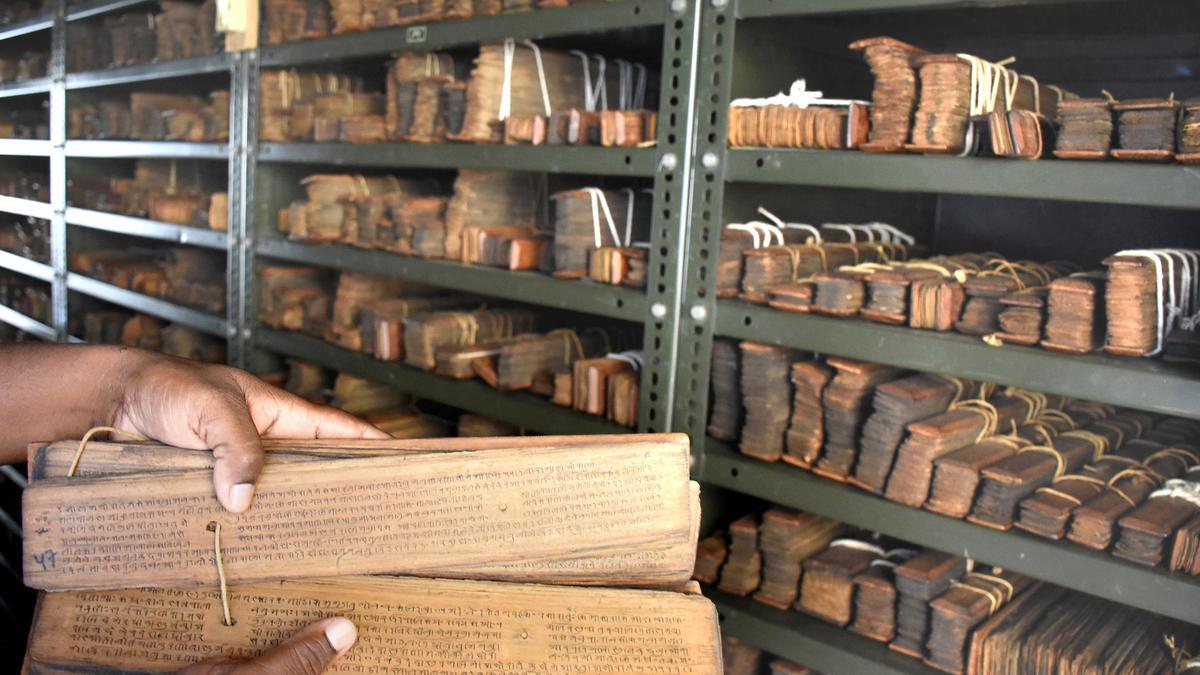
The Union Ministry of Culture is set to “revive and relaunch” the National Mission for Manuscripts (NMM) and is mulling the formation of an autonomous body to help preserve ancient texts in India.
Presently, NMM is a part of the Indira Gandhi National Centre for Arts.
The new body, likely to be named the National Manuscripts Authority, will be an autonomous entity under the Ministry, sources told The Hindu.
The Ministry had held a meeting on October 14 to discuss the way forward.
The meeting, chaired by Culture Minister Gajendra Singh Shekhawat, was attended by experts such as former chairperson of the Central Institute of Indian Languages, Mysore, and well-known linguist Udaya Narayana Singh, professor K.
Ramasubramanian of IIT Bombay, M.
A.
Alwar of the Samskriti Foundation, Sudha Gopalakrishnan, founder director of NMM, Chamu Krishna Shastry, chairman of the Bhartiya Bhasha Samiti, and Shrinivasa Varakhedi, vice-chancellor of the Central Sanskrit University, Delhi.
The expert group also included a programme manager from Google Arts and Culture.
The meeting took stock of NMM’s achievements since its establishment in 2003, Mr.
Singh told The Hindu.
The NMM informed that till date a metadata of 52 lakh manuscripts has been prepared and roughly over 3 lakh titles have been digitised, he said.
However, only one-third of them have been uploaded.
Concerns were expressed on mismatches between digitised metadata and actual manuscripts which were now being hand-corrected.
“If it has not been properly done, it is a huge task,” Mr.
Singh said.
A senior NMM official said that out of the nearly 1.
3 lakh manuscripts uploaded, 70,000 were available for viewing because there was no “access policy”, which means that there is no incentive for private owners to make manuscripts available with them for viewing.
Around 80% of manuscripts in India are with private parties.
The NMM also informed that over the past 21 years, it had undertaken preventive and curative conservation of 9 crore folios.
On the future roadmap, Mr.
Singh said that there was a discussion on setting up of chairs in universities abroad that have departments of ancient Indian studies.
The experts opined that these chairs could liaise between the universities and NMM.
“One of my suggestions was that there should be some intellectual property right and legal expert in this group,” he said.
Discussions took place on the need to stop the sale of manuscripts outside India and providing financial help to private owners to preserve the manuscripts as well as their registration.
Mr.
Singh stressed on the importance of collating information and preservation of non-Brahmi and other lesser-known scripts.
.