India's Ethanol Push: A Path to Energy Security
New Delhi: India is taking significant steps toward securing its energy future by embracing sustainable practices like ethanol blending.
As the world’s third-largest energy consumer, the country has traditionally depended on oil imports to meet its growing energy demands.
This reliance not only poses challenges to energy security but also leads to a substantial outflow of foreign currency.
However, with ethanol blending, India has a promising opportunity to reduce its dependence on imported oil while addressing environmental concerns.
Ethanol, a byproduct of sugarcane processing, can be mixed with petrol, cutting down on fossil fuel consumption and reducing harmful carbon emissions that contribute to climate change and public health issues.
The practice of blending ethanol with petrol began in 2001 as a pilot project.
Yet, for many years, progress was slow, and ethanol production remained stagnant.
Only recently, through a series of comprehensive reforms, has India been able to unlock the full potential of this initiative.
These reforms are now driving substantial outcomes, not just by enhancing energy security, but also by revitalizing rural economies.
Ethanol production offers a new source of income for farmers, supporting the agricultural sector and fostering economic growth in rural areas.
The government’s proactive approach to ethanol blending is evident in its decision to advance the target of 20 per cent ethanol blending from 2030 to 2025, demonstrating a strong commitment to sustainable energy practices.
During the 7th G-STIC Delhi Conference, Hardeep Singh Puri, Minister of Petroleum and Natural Gas, emphasized India’s growing success in ethanol blending and its broader commitment to sustainable energy solutions.
He highlighted that, in recognition of the progress made, the government has already begun planning for the future by exploring goals beyond the 20% ethanol blending target.
This forward-looking approach indicates that India is not only focused on meeting its immediate energy needs but is also preparing for long-term sustainable energy solutions to address future demands.
Ethanol is one of the primary biofuels, naturally produced through the fermentation of sugars by yeasts or through petrochemical processes like ethylene hydration.
It is widely used not only as an alternative fuel source but also in various industries as a chemical solvent and in the synthesis of organic compounds.
Ethanol also has medical applications as an antiseptic and disinfectant, adding to its versatile uses.
In the context of India’s rising energy demand, driven by factors such as a growing economy, an expanding population, increasing urbanization, and evolving lifestyles, ethanol plays a critical role.
As of March 2024, around 98 per cent of the fuel used in the road transportation sector comes from fossil fuels, while only two per cent is met by biofuels like ethanol.
This dependency on fossil fuels presents challenges related to energy security, foreign currency outflow, and environmental impact.
Ethanol, as a domestically produced biofuel, offers a strategic opportunity to reduce the country’s dependence on imported fossil fuels.
When used responsibly, biofuels like ethanol are more environmentally friendly and sustainable, contributing to a cleaner energy landscape.
Additionally, ethanol production and usage align with national goals like generating employment, promoting the “Make in India” initiative, supporting the Swachh Bharat Mission, and contributing to the doubling of farmers' incomes.
It also fosters the creation of wealth from waste, further enhancing its importance to India’s economy and energy security.
Under the leadership of Prime Minister Narendra Modi, the government has embarked on a series of comprehensive reforms aimed at enhancing energy security, combating climate change, and boosting the rural economy.
An indicative target of 20 per cent ethanol blending in petrol was initially set for 2030 under the EBP Programme.
However, in 2020, the Cabinet Committee on Economic Affairs (CCEA) advanced this target to 2025, reflecting the government's commitment to accelerating ethanol usage.
The progress of India’s Ethanol Blended Petrol (EBP) Programme has been noteworthy, with the ethanol production capacity more than doubling in the last four years to reach 1,623 crore litres as of September 18, 2024.
This substantial increase highlights the government's commitment to enhancing the role of ethanol in the nation’s energy landscape.
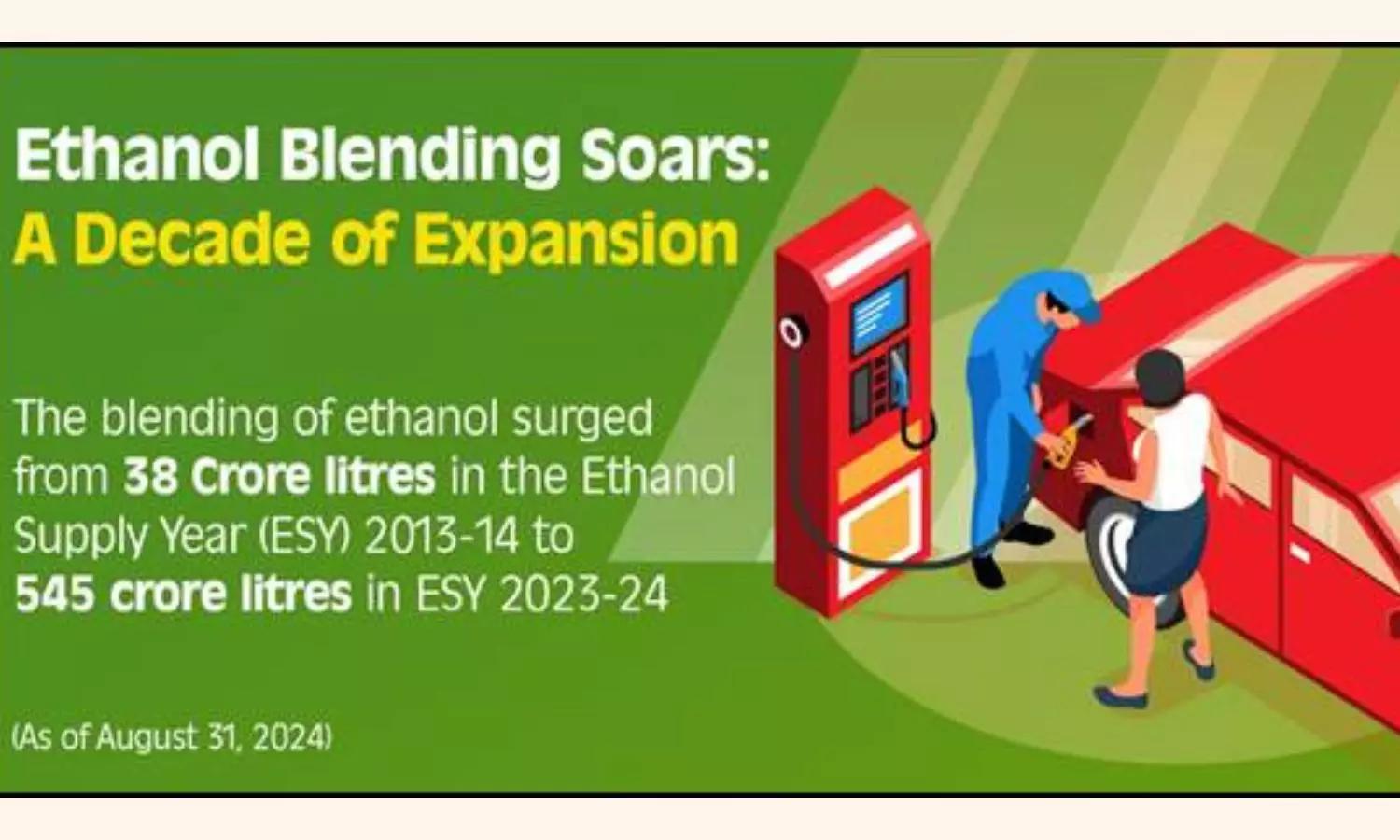
In the Ethanol Supply Year (ESY), which runs from November to October, the blending of ethanol with petrol stood at 38 crore litres with a blending percentage of 1.
53 per cent in ESY 2013-14.
Over the following years, the government implemented various initiatives that led to remarkable growth in ethanol blending.
By ESY 2020-21, the blending volume surged to 302.
3.
.
.
.