The storm that wasn’t: how Chennai fared
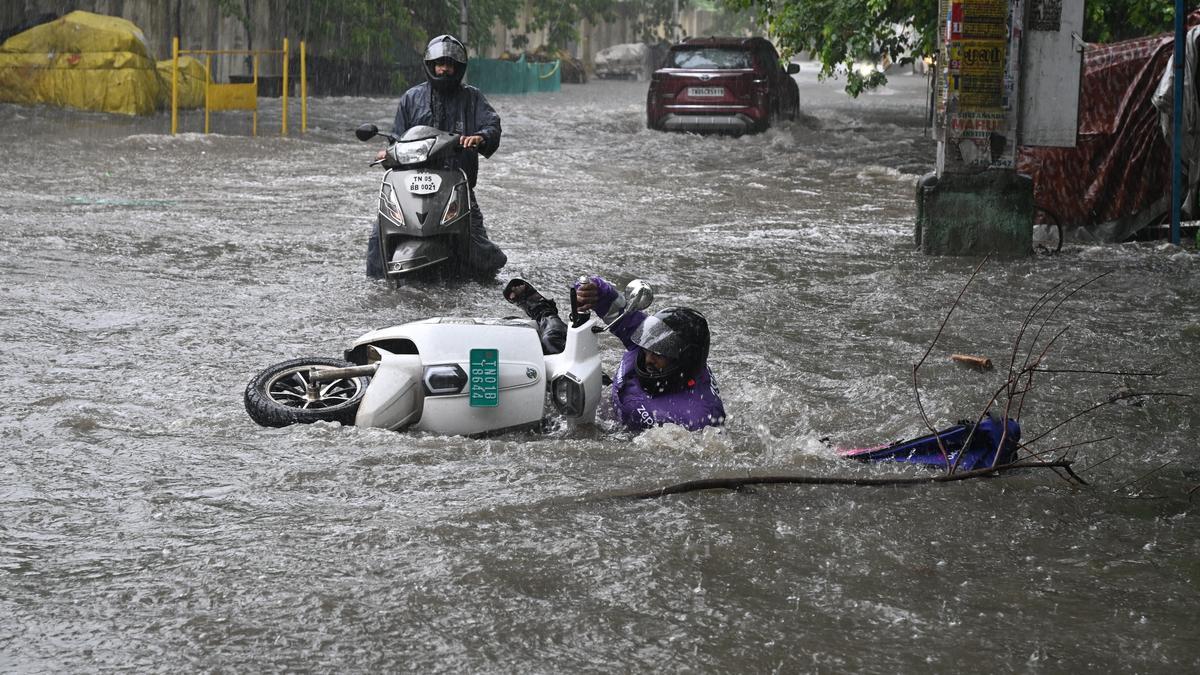
When this year’s first rain spell of northeast monsoon arrived with a downpour a few days ago, scenes of inundation from previous years were indeed repeated.
But many areas of the city recovered within a day, partly because of the concerted efforts and immediate preparation of Tamil Nadu government agencies to face extreme situations and weather warning, and also because the rain stopped earlier than expected.
Also Read: In Pictures | Aftermath of Tamil Nadu rains
Seeking lessons from last year’s Cyclone Michaung that spelled disaster, the government had prepared for disaster management and planned for flood-relief and rescue operations.
About 300 flood-relief centres were opened and food was distributed through 98 community kitchens.
The field reviews by Chief Minister M.
K.
Stalin, Deputy Chief Minister Udhayanidhi Stalin, Ministers and officials helped accelerate flood-management work in different parts of the city.
Also Read: How Cyclone Michaung formed, intensified, rained, and dissipated | Explained
Sanitation workers and Greater Chennai Corporation workers persevered round the clock, bailing out stagnant water with heavy-duty pumps and clearing garbage and sewage.
The appointment of nodal officers to coordinate among agencies helped to monitor the work.
Alert downgraded
Although Chennai recorded an average rainfall of 13 cm-14 cm on October 15, parts of the city and those on the fringes received more than 20 cm.
Cholavaram, with the heaviest rainfall of 30 cm, Red Hills with 28 cm, and Avadi with 25 cm, bore the brunt.
In contrast to the extreme weather event predicted for over two days when the Regional Meteorological Centre issued a red alert, rainfall ceased on October 16 as the depression changed its trajectory and weakened.
S.
Balachandran, Additional Director-General of Meteorology, Chennai, said, “There is no perfect forecasting system, and not all systems are fully understood.
Each depression behaves differently due to thermodynamical conditions.
When the system was in the ocean, there was a risk involved; which is why, we issued the alert.
It was to caution people not to panic.
Understanding weather systems is a continuous process.
”
Weather experts suggested that extension agents be trained in assisting disaster management agencies in translating forecasts into alerts.
Raghu Murtugudde, professor at IIT Bombay, said, “The extension agents will be experts in communicating the alerts in regional languages and guiding people to appropriate actions.
There are some systematic biases in extreme rainfall predictions since the tropical systems explode rapidly and are hard to predict.
”
The Chennai Corporation estimated that about 540 localities reported waterlogging, including TNHB Colony at Korattur, Venus Colony at Alwarpet, and G.
K.
M.
Colony at Kolathur.
Korattur and Red Hills were among the worst-affected places, where localities were marooned well after the rainfall abated.
People had to be rescued in boats at Korattur and drones were deployed to deliver relief materials to residents of Kumaran Colony at Red Hills.
Water receded quickly in many inundated areas of south Chennai by the morning of October 16.
Geeta Padmanabhan of Thiruvanmiyur said that while a few avenues escaped as drains were desilted, residents had to endure water stagnation for two days in areas like Kamaraj Nagar as the storm-water drain was not desilted.
In areas around Old Mahabalipuram Road, which get engulfed in water every monsoon, residents like Raj Natarajan of Semmencheri expressed concerns over recurrence of waterlogging in some areas unless Okkiyum Maduvu and the marsh opposite the ELCOT SEZ are cleaned.
But it was also true that areas prone to flooding showed visible changes following interventions.
The interventions and infrastructure improvements since last year did bring about a change in areas including parts of Rajiv Gandhi Salai, Tansi Nagar, S.
V.
S.
Nagar at Valasaravakkam, Porur junction, Poonamallee High Road near St.
Andrew’s Church, and Narayanapuram.
Also Read: Chennai Rains: Volunteers for the season
Extensive desilting of storm-water drains and construction of a new drain network to a distance of 785 km, out of the planned 1,135 km across the city, have made the difference this time, say Corporation officials.
The reconstruction of the Thanikachalam Nagar drain, which was in a shambles for years, seems to have resolved the recurrent issues of flooding at Kolathur and Madhavaram.
The storm-water drain built by the Highways Department helped 12 stagnation points on the East Coast Road.
Hiccups persist
However, there were hiccups in terms of the tardy implementation of the storm-water drain and flood-mitigation projects, missing and incomplete links in the drains, and lack of connectivity between the drains and the water channels.
A delay in getting approval from the Highways Department held up the construction of a channel linking the Narayanapuram lake to the Pallikaranai marsh through the 200-Feet Radial Road.
The Chennai Corporation has identified nearly 50 locations, including Vembuliamman Koil Street at K.
K.
Nagar, for gaps in the drain network.
The Metro Rail construction poses a major challenge this monsoon.
It has aggravated the waterlogging in south Chennai where residents say the drains get clogged by debris.
Nearly 22 locations in the vicinity of the Metro Rail construction sites in various zones were flooded.
For instance, the Corporation installed 19 pumps to bail out water from Millers Road and Purasawalkam High Road, but water drained only after a few days.
“Workers dump debris clogging the drains.
They are unaware of the consequences.
Excavation at the construction site takes away road space and obstructs the natural flow of water,” says a source at Chennai Metro Rail Limited (CMRL).
The situation remains grim in some localities of north Chennai that stare at imminent waterlogging owing to incomplete civic projects.
Pulianthope, Pattalam, Perambur, Choolai, and Vyasarpadi, which have faced inundation for years, remained flooded even after the rain stopped on October 16.
Development projects executed at Madipakkam, another flood-prone area, had open ends, making the locality vulnerable to inundation.
Kuberan Nagar Extension, Ram Nagar South Extension, LIC Nagar, and Govindasamy Nagar were affected, owing to incomplete road projects and storm-water drains and the absence of link to waterways.
P.
Saravana Kumar, founder of Madipakkam Social Service Trust, points out that rain in the days to come would determine the impact of the storm-water drain.
The surplus water channel from the Keelkattalai lake needs to be improved to end flooding at Madipakkam.
However, Corporation officials say that compared with last year, water stagnation has come down at Madipakkam after the storm-water drain was built and roads were restored.
A few streets suffered from minor issues.
Corporation Deputy Commissioner (Works) V.
Sivakrishnamurthy says the work to prevent inundation near the Ganesapuram subway in north Chennai will be completed in a few weeks as Southern Railway has agreed to permit line block to build a culvert beneath the tracks.
In neighbouring Tiruvallur district, which was battered by massive rain, officials of the rank of Deputy Collector supervised the work in taluks and ensured better coordination.
“We have no control over water release as the Araniyar and Kosasthalaiyar originate in Andhra Pradesh.
This time, we got live updates from Andhra Pradesh through our engineers,” says Collector T.
Prabhushankar.
The space for buffer storage in major reservoirs saved the city from riverine flooding this time and the rivers’ capacity has been improved by 30%.
The projects implemented by the Water Resources Department (WRD) to improve major waterways and surplus courses and the controlled water release from the lakes instilled confidence in officials of managing a rainfall of up to 30 cm-40 cm.
The department implemented additional projects costing Rs.
2.
30 crore to desilt the major waterways.
However, Virugambakkam and Anna Nagar residents point to the insufficient carrying capacity of canals, including Virugambakkam-Arumbakkam canal and Otteri Nullah, and lack of desilting.
They flag the risk of floodwater spillover and malfunctioning of the drain network during the rain.
Permanent solution?
The government had been preparing for three months to tackle the monsoon, said Mr.
Stalin.
He also said a permanent solution to water stagnation would be found soon.
The pending projects, based on the recommendations of the Advisory Committee for Mitigation and Management of Flood Risk in the Chennai Metropolitan Area, led by former IAS official V.
Thiruppugazh, would be finished soon.
Mayor R.
Priya said, “We shortlisted the issues faced last year, constituency-wise, and started sorting them out since July.
We had plans for 35 low-level areas and installed 100-HP motors in flood-prone locations.
A coordination committee was formed to address issues of waterlogging where the Metro Rail project is in progress.
” She added, “We are working to remove the floating garbage from the canals and clean the silt catch pits.
We are planning to resolve issues in areas where we have faced problems so far this year.
”
Two government agencies that managed to function almost seamlessly were Chennai Metrowater and Tangedco.
Power shutdown was averted except at a few places like west Velachery and T.
Nagar where water stagnation on roads and leakage of underground cables resulted in the outages.
The sewers carried nearly 953 million litres of sewage on October 15, as against the daily load of 650 million litres.
Additional sewer equipment, replacement of sewers in vulnerable locations, and monitoring of leaks through the GIS command centre helped the water agency.
Sources in the WRD note that unless the 29 macro drains, including Otteri Nullah, Veerangal Odai, and Captain Cotton Canal, are made free of encroachments and desilted, the scope of flood control will be limited.
A wholistic, long-term flood management plan for the entire Chennai Metropolitan Area, instead of Chennai in isolation, would make the city flood-proof.
The government must frame a policy to freeze development near waterbodies and waterways.
Experts say the city is not fully prepared for flood management and mitigation.
Chennai is largely involved in firefighting rather than finding comprehensive solutions for urban flood resilience.
S.
Thirunavukkarasu, former Public Works Department official who specialises in hydraulics and hydrology, says, “What we are doing now, including construction of storm-water drains, is crisis management.
We need to find the root cause of flooding in each watercourse.
A comprehensive policy for restoration of waterbodies, with stringent strategies to increase storage to match their annual run-off, and re-establishing the missing links is needed.
” Deepening waterbodies would be one of the strategies to shield Chennai from floods and droughts, he adds.
(With inputs from Aloysius Xavier Lopez, Sunitha Sekar, R.
Aishwaryaa, Deepa H.
Ramakrishnan, R.
Sivaraman, R.
Srikanth, Meghna M.
and Priyali Prakash ).