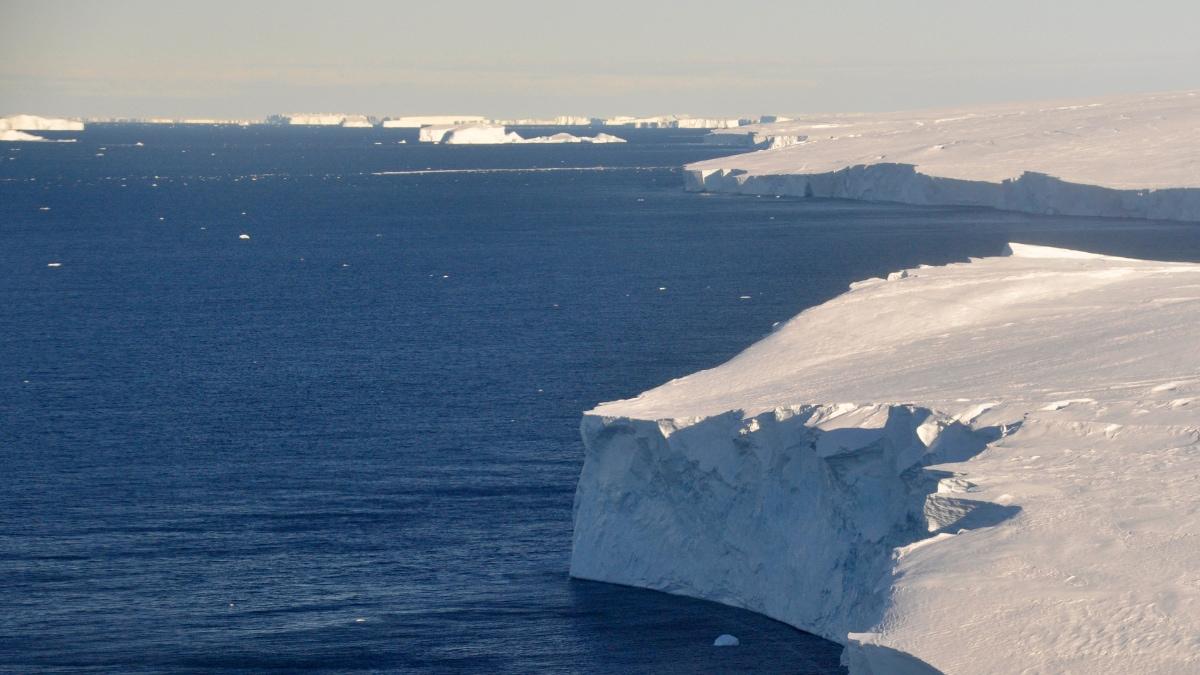
Can ‘Underwater Curtain' Stop This Doomsday Glacier From Melting? | Explainer
Ice is melting across the globe, threatening to raise sea levels and submerge major coastal cities, including Mumbai.
Scientists are particularly concerned about the Arctic and Antarctic regions, with the most pressing worry being Antarctica’s rapidly melting Doomsday Glacier, a significant contributor to this potential crisis.
In a bid to mitigate the risks, scientists are exploring innovative solutions, including the deployment of a massive underwater ‘curtain’.
The melting of the Doomsday Glacier alone could inundate the eastern coast of America.
To avert this, researchers have proposed deploying a thick sheet of artificial glacier over the seawater.
Another suggestion involves cooling the bedrock beneath the Thwaites Glacier, also known as the Doomsday Glacier, to prevent warm water from infiltrating it.
(News18 Hindi)
The Thwaites Glacier, a colossal ice mass covering 192,000 square kilometres in West Antarctica, is located east of Murphy Mountain on the Walgreen Coast of Marie Byrd Land.
Climate change is accelerating its melting rate, potentially raising global sea levels by 10 feet.
What will happen if the Thwaites Glacier melts?
The potential consequences of the glacier’s complete melting are dire, with coastal cities like New York, Charleston, Atlantic City, and Miami facing catastrophic flooding.
To address this looming threat, researchers from the Climate System Engineering Initiative at the University of Chicago have published a report proposing a new initiative.
“Our argument is that we should start funding this research from now, so that when the water is already reaching our ankles, we do not make any panicked decisions,” urged Douglas MacAyeal, a professor of geophysical sciences and co-author of the report.
Experts have consistently emphasised the need for proactive measures to address such challenges.
How will this work?
The report proposes pumping seawater to the surface of the Doomsday Glacier, where it would freeze due to the frigid air temperatures, thickening the glacier.
However, the authors acknowledge the inherent risks and costs associated with this idea.
The salinity of seawater could hinder the ice’s ability to freeze or maintain a uniform frozen state.
Additionally, pumping vast quantities of seawater requires substantial energy.
(Shutterstock)
UK-based startup Real Ice has been exploring the concept of pumping seawater since 2019, with promising results from field trials in Canada.
However, large-scale deployment would require approximately Rs 506.
34 billion annually and consume significant energy.
Scientists have also proposed other geo-engineering solutions to halt glacial melting.
Some experts deem these ideas “revolutionary” but caution that geo-engineering “would be difficult or impossible to achieve” and could distract from the more pressing need to reduce carbon emissions.
Gernot Wagner, a climate economist at Columbia Climate School, said, “When we talk about glacial geo-engineering, we have to tell the truth, which is that it is not a solution to climate change.
At best, it is a pain reliever.
”.