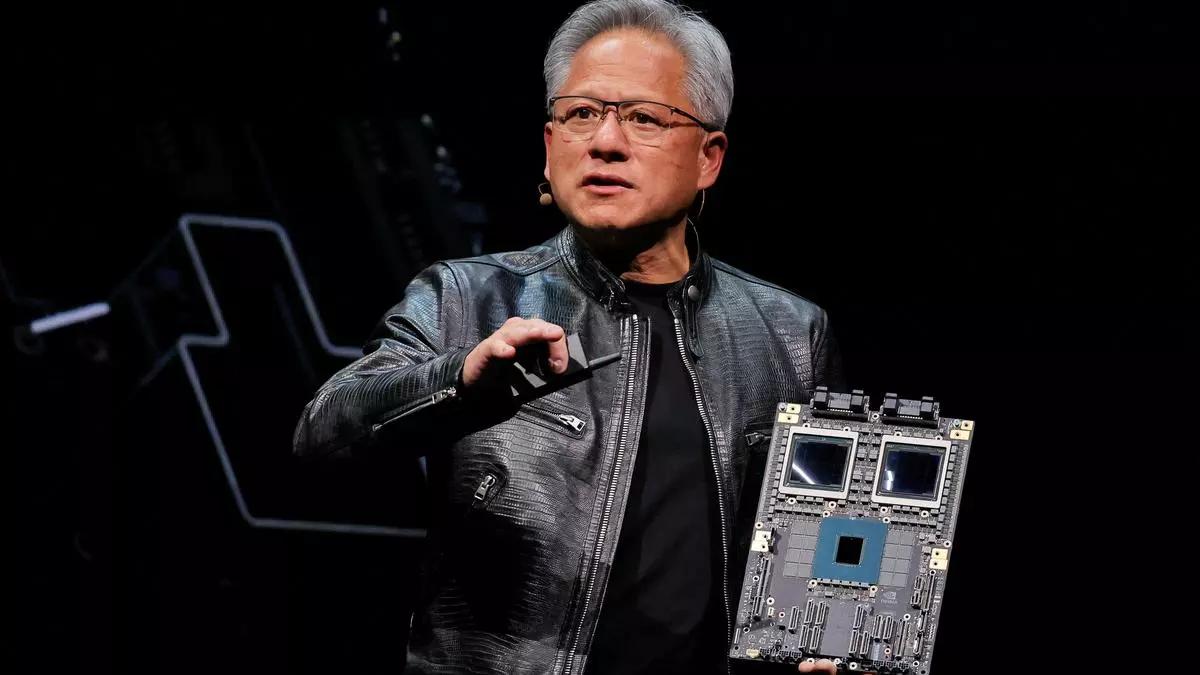
Nvidia: The lynchpin of the AI revolution
Nvidia’s transformation from a pioneering graphics company to the lynchpin of the artificial intelligence (AI) era is a story of visionary leadership, bold innovation, and the sheer power of scalable computation.
Nvidia’s current valuation at $3.
53 trillion makes it one of the world’s most valuable tech giants, amid speculations that it could reach $50 trillion within the next decade.
Under CEO Jensen Huang, Nvidia has expanded its core business beyond gaming to transforming industries worldwide, positioning itself as the essential infrastructure provider in today’s AI revolution.
Nvidia’s meteoric rise is catalysed by three levers: scalability of Nvidia’s graphics processing units (GPUs) to drive AI advancements; Huang’s model of strategic foresight; and an intricate web of cultivated global partnerships with Google, Meta, and OpenAI, among others.
The bitter lesson: Powering AI through scalable computation
Central to Nvidia’s ascent is a concept known as the “bitter lesson”, proposed by AI researcher Richard Sutton.
Sutton challenged the early assumptions that AI development depended on creating intelligent systems through specialised, human-like algorithms.
Instead, he argued that real advancements come from leveraging massive computational power to process vast amounts of data — allowing AI systems to uncover insights autonomously.
This paradigmatic idea triggered a need for scalable hardware, and Nvidia, with its powerful GPUs, leveraged it.
Originally designed for gaming, Nvidia’s GPUs excel at processing large volumes of data, providing the computational power required for today’s AI models.
This strength has made Nvidia indispensable in training extensive AI systems, including OpenAI’s ChatGPT, and Anthropic’s Claude.
Nvidia’s hardware does not just support AI, it also accelerates its evolution, aligning perfectly with the industry’s transition towards general-purpose, computation-intensive models.
As AI adoption deepens, the demand for scalable computation positions Nvidia’s GPU as the central nervous system for the entire AI ecosystem.
AI already accounts for the largest share of Nvidia’s revenue.
, which has risen from $11.
72 billion in FY2019 (yearly) to $30.
04 billion in just Q2 of FY2025 (quarterly).
Over this period, the contribution of the data center segment to Nvidia’s total revenue climbed from 25 per cent to an estimated 87.
5 per cent, a testimony to its strategic emphasis on analytics and AI-driven solutions.
Huang’s visionary leadership
Huang’s approach combines strategic foresight with practical resilience.
His leadership style emphasises agility and adaptability, evident in his “collective intelligence” model, where over 60 executives report directly to him.
This hands-on, flat-structured approach enables Nvidia to pivot quickly to meet market shifts and drive continuous innovation.
His motto “We’re only 30 days away from going out of busines” has ingrained a culture of urgency and accountability, creating a company unafraid to adapt and experiment.
Huang’s leadership hasn’t been without challenges.
Nvidia has faced numerous controversies, from high-stakes legal battles with Intel to regulatory scrutiny over the attempted acquisition of ARM.
Yet, Huang has consistently steered Nvidia with a focus on long-term vision, navigating setbacks with strategic pivots.
In the early 2000s, he faced Nvidia’s near-collapse after its NV1 chip flopped in the market.
Huang’s response — doubling down on innovation with the RIVA 128 and the eventual development of the world’s first GPU — reinforced his reputation for resilience and foresight.
Huang’s approach is not limited to organic growth but encompasses a calculated mix of acquisitions, partnerships, and alliances.
Acquiring Mellanox Technologies in 2019 allowed Nvidia to expand into high-performance computing, and its early support for OpenAI positioned it as the preferred provider for AI infrastructure.
Through each partnership, Nvidia has not only broadened its reach but also fortified its central position in the rapidly evolving AI ecosystem.
Building Nvidia’s moat
Beyond hardware, Nvidia has developed a powerful “moat” through its proprietary CUDA platform, creating an ecosystem that extends Nvidia’s reach across industries.
CUDA enables GPUs to support applications beyond gaming, ranging from healthcare diagnostics to real-time financial analysis.
This ecosystem has become a closed loop for developers, making Nvidia hardware essential for those who want to leverage GPU acceleration for complex computations.
Partnerships with AWS, Microsoft, and Google further deepen CUDA’s reach, creating an interdependent system that other hardware providers have struggled to replicate.
This ecosystem is more than a competitive advantage — it’s a critical infrastructure for AI, with industries increasingly reliant on Nvidia-powered platforms for everything from autonomous driving to intelligent logistics.
The strategic lock-in effect makes Nvidia not just a hardware company but the underlying architecture for AI applications globally.
Scaling AI: A $50-trillion opportunity
Financial projections suggest Nvidia’s success story has just begun.
With AI demand estimated to grow by 60 per cent annually, analysts like James Anderson project that Nvidia’s valuation could soar to $50 trillion.
Nvidia’s increasingly central role in the AI infrastructure ecosystem, solidified by partnerships, acquisitions, and advancements in AI-specific GPUs, the increasing need for high-powered GPUs across industries make such estimates a tangible reality.
Nvidia’s emerging country actions, such as the recent collaboration with Reliance Jio, only reiterate how Huang’s unique blend of scalable computation, strategic leadership, and collaborative partnerships further strengthens its growing lynchpin status.
(Simarjeet Singh and Sanchita Kuchi are assistant professors at Great Lakes Institute of Management, Gurgaon, and Raj Krishnan Shankar is an associate professor at Chennai campus).